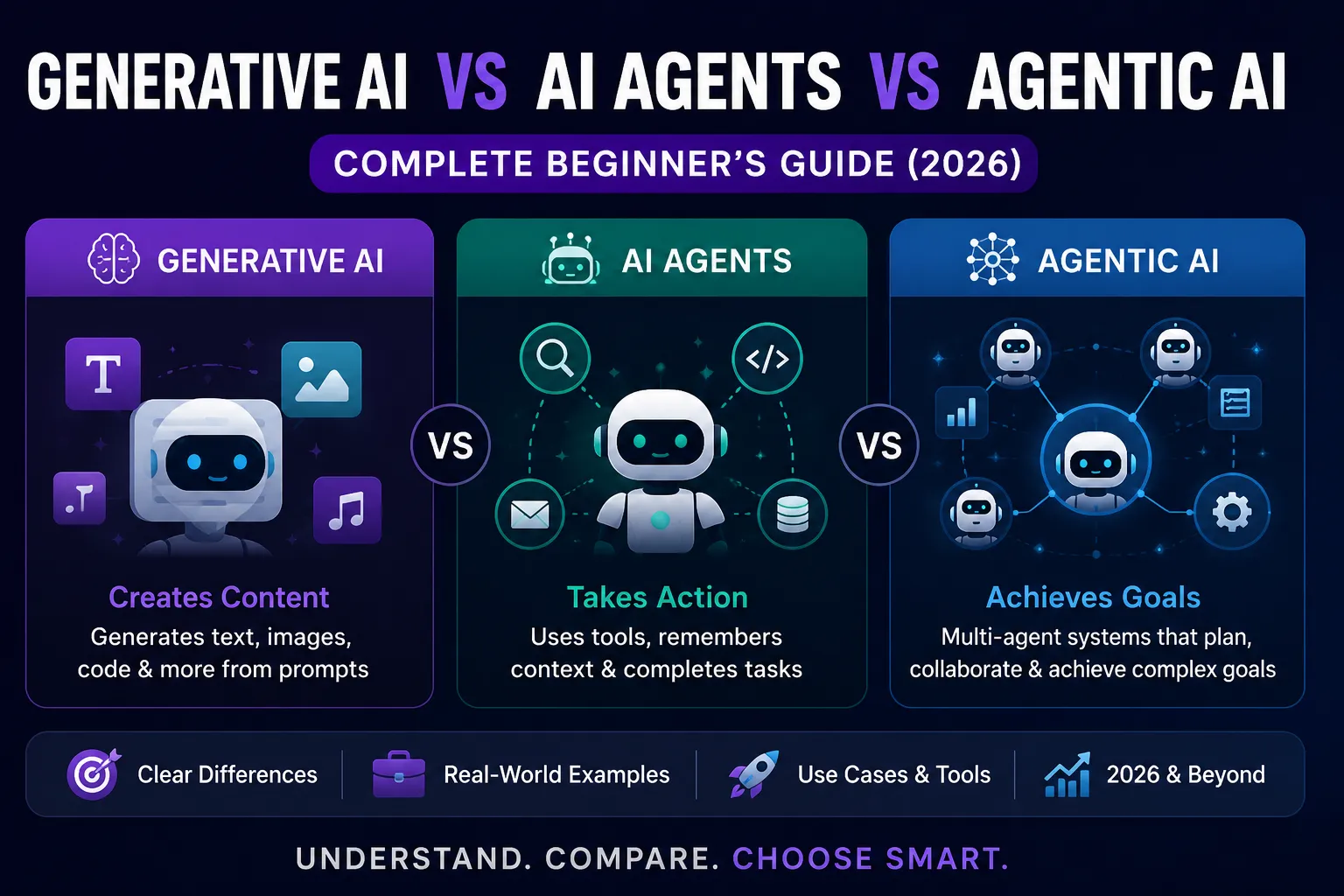
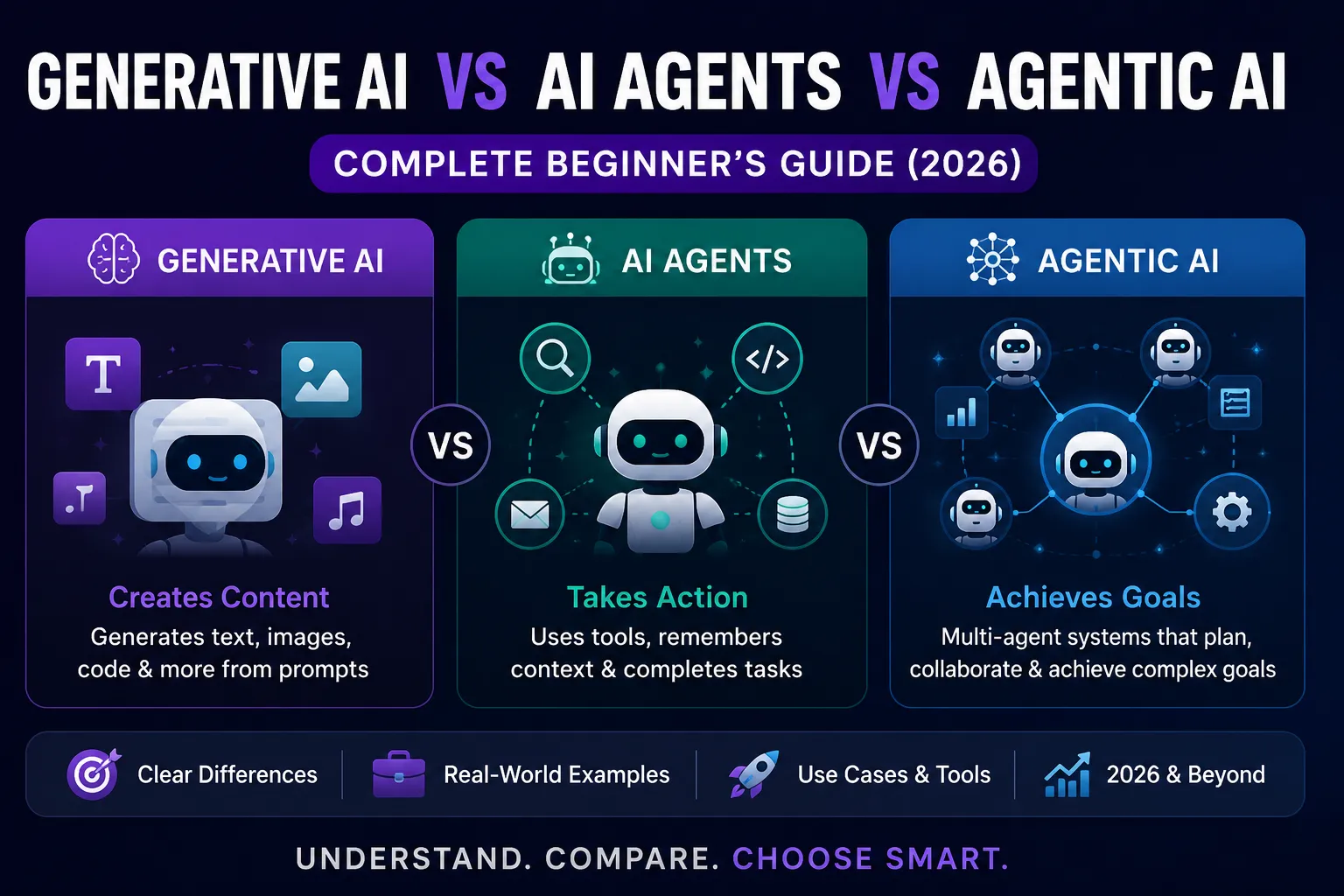
Generative AI, AI Agents, and Agentic AI aren't three separate technologies — they're three stages of the same evolution. Understand what each one is, how they compare, and why every business and career in 2026 needs to know the difference.
Introduction: Why This Matters Right Now
Let's start with a question that is being asked in every boardroom, classroom, and content feed in 2026: What's the difference between Generative AI, AI Agents, and Agentic AI?
If you're confused, you're not alone. The words are thrown around so loosely that they're almost interchangeable in daily conversation. But here's the thing — they're not the same. They're not even really comparable in the way most people assume. Each one is a stage in a bigger story, and once you understand that story, the entire AI landscape clicks into focus.
That's the goal of this guide. No jargon walls, no hype, no 40-minute video where you lose interest in the first two minutes. Just a clear, practical walkthrough of what these three terms actually mean — and what they mean for you, whether you're a curious beginner, a founder, or a professional trying to stay relevant.
By the end of this guide, you'll be able to explain the differences to someone else, spot the terms in the wild, and make smarter decisions — in your projects, your business, or your next career move.
The One-Minute Summary
| Concept | What it does | Best analogy |
|---|---|---|
| Generative AI | Creates content (text, images, code, music) from prompts | A brilliant assistant that answers when asked |
| AI Agents | Use models + tools + memory to complete multi-step tasks | An employee you give a goal and then walk away from |
| Agentic AI | Systems of agents working together autonomously | A whole team running without a manager in the room |
Generative AI is a capability. AI Agents are a framework. Agentic AI is the movement that builds on both.
Part 1: Generative AI — The Content Creator
Let's start with the term you're probably most familiar with: Generative AI.
Generative AI refers to a category of artificial intelligence systems designed to create new content — text, images, audio, video, and code — based on patterns learned from vast amounts of training data.
When you ask ChatGPT to write an email, ask Midjourney to create a logo, or ask ElevenLabs to clone your voice, you're using Generative AI. It's the "content generation" layer of the AI ecosystem. It's what made AI famous in the first place.
The models behind it — LLMs like GPT-4o, Claude, and Gemini, and diffusion models like Stable Diffusion — are trained to predict what comes next. Given a prompt, they generate the most probable continuation. That's it. No reasoning in the human sense, no goals, no autonomy. Just extremely sophisticated pattern matching that produces stunning results.
A prompt: "Write a product description for a reusable coffee cup."
The model predicts tokens one at a time based on learned patterns.
A polished paragraph of text — ready in seconds, not hours.
- Drafting emails and documents
- Generating marketing copy and slogans
- Creating images, art, and design mockups
- Writing and debugging code
- Translating between languages in real time
- Summarizing long reports and videos
Generative AI waits to be asked. It won't start a task on its own, verify its own work, or follow up. It's reactive, not proactive.
Part 2: AI Agents — The Task Completer
Now we take a step up. An AI Agent is a system that combines an LLM with three extra ingredients: tools, memory, and a goal.
Where Generative AI just produces output, an agent can do things. It can browse the web, write to a file, call an API, check a database, run code, and then use the results of those actions to decide what to do next. It loops: observe → think → act → observe again, until the goal is reached.
This is the framework made famous by libraries like LangChain, LlamaIndex, CrewAI, and AutoGen. Agent frameworks like these became the standard way to build "AI assistants that actually get things done" — booking flights, doing research, triaging support tickets, generating and running code, and more.
A clear objective: "Find the cheapest flight to Tokyo."
Web search, APIs, calculators, code execution.
Remembers earlier steps so it doesn't repeat itself.
Observe → think → act, repeated until done.
A Generative AI model produces output. An AI Agent produces outcomes — it acts on the world and gets back to you when it's done.
Part 3: Agentic AI — The Autonomous Movement
Here's where the terminology gets fuzzy — and it's worth being precise. Agentic AI is not simply "AI agents, plural." It's a broader concept: AI systems that can act autonomously, make decisions, and pursue goals with minimal human intervention — often by orchestrating multiple agents working together.
Think of it this way: Generative AI is a capability. AI Agents are a framework. Agentic AI is the movement — the wave of products and platforms built on that capability and framework, designed to run tasks end-to-end without a human babysitting every step.
Agentic AI is what "AI that works for you while you sleep" means. You give it a high-level goal — "Plan and book my client's week of meetings across all their tools" — and it decomposes that into subtasks, delegates them to specialized agents, uses tools, checks its own work, and comes back with results.
-
1
Goal intake
You describe the outcome you want in plain language.
-
2
Planning
The orchestrator breaks the goal into ordered subtasks.
-
3
Delegation
Specialized agents handle research, writing, data, and actions.
-
4
Tool use
Agents call APIs, search the web, and write to real systems.
-
5
Self-verification
The system checks outputs against the goal and fixes errors.
-
6
Delivery
Results land in your inbox or dashboard — with a summary.
Not everything labeled "agentic" is fully autonomous. In 2026, the smartest products use human-in-the-loop checkpoints for anything risky — approvals, money, or external communication.
Part 4: Head-to-Head — The Full Comparison
Here's the same comparison that opens this guide, but in full detail. Keep this table handy — it answers 90% of the questions people ask about these three terms.
| Dimension | Generative AI | AI Agents | Agentic AI |
|---|---|---|---|
| Core job | Generate content | Complete tasks | Pursue goals autonomously |
| Autonomy | None — reactive | Moderate — task-level | High — goal-level |
| Tools & memory | No (single call) | Yes | Yes, multi-agent |
| Initiative | Waits for prompts | Works within a task | Works toward an outcome |
| Best for | Content & ideas | Repeatable workflows | Complex, cross-tool goals |
| Examples | ChatGPT, Claude, Gemini, Midjourney | LangChain/CrewAI apps, coding copilots | OpenAI Operator, enterprise orchestration platforms |
- Generative AI: "I can create things on request."
- AI Agents: "I can get a task done for you."
- Agentic AI: "I can run a whole goal for you."
Part 5: Real-World Applications
The best way to make these distinctions stick is to see them at work. Here's what each one looks like in the real world — and how companies are actually using them in 2026.
| Industry | Generative AI does | Agents & agentic AI do |
|---|---|---|
| Marketing | Writes ad copy, social captions, and campaign ideas | Monitors trends, drafts, A/B tests, and publishes posts on autopilot |
| Customer support | Answers FAQs and drafts replies | Resolves tickets end-to-end, escalates edge cases, updates the knowledge base |
| Software development | Suggests code and explains errors | Opens issues, fixes bugs, runs tests, and opens pull requests |
| Finance | Summarizes reports and drafts communications | Reconciles invoices, flags anomalies, and prepares regulatory filings |
| Healthcare | Drafts patient notes and simplifies discharge instructions | Schedules appointments, triages intake forms, and coordinates follow-ups |
| Education | Generates lesson plans and practice questions | Builds personalized study paths and auto-grades submissions |
In every row, Generative AI creates, while agents complete the surrounding work — the searching, checking, acting, and finishing that turns a draft into a done job.
Part 6: The Limitations — Honest About the Hype
Every technology has limits, and the agentic wave is no exception. Knowing these limitations is exactly what separates people who benefit from AI from people who get burned by it.
Generative models can confidently produce false information. The more autonomous the system, the further a mistake can spread before a human notices.
Two runs of the same agent can take different paths and produce different results. That's a feature for creativity, but a headache for reliable processes.
In a chain of agents, one small error can amplify as it passes down the line. This is why guardrails and checkpoints exist — and why "full autonomy" is still rare.
Each step in an agent loop costs tokens and compute. Multi-agent systems also need careful architecture, monitoring, and maintenance — they're not a free win.
Use Generative AI for ideas and drafts. Use single agents for well-defined workflows. Use agentic systems for complex goals with clear success criteria — and always keep a human in the loop where risk is high.
Part 7: Career & Business Advice for 2026
Here's the part everyone actually wants. What should you do about all this — in your job, your studies, or your company?
- Learn to prompt, evaluate, and verify model output — that's the new baseline skill.
- Build one project that wires an LLM to real tools (search, spreadsheets, APIs).
- Practice writing clear, measurable goals — agentic AI turns them into prompts.
- Stay current: the field changes faster than any course syllabus.
- Start with one narrow, high-frequency workflow, not a grand overhaul.
- Define success metrics before you build — you can't evaluate what you can't measure.
- Put guardrails and approval steps on anything touching money or customers.
- Retrain your team on what AI can now do end-to-end, and reallocate people to judgment roles.
The winners won't be the people who use AI to write faster. They'll be the people who use it to operate whole workflows faster — and who know when to trust the output and when to double-check it.
Part 8: How They All Work Together
The reason these three terms get tangled up is that, in production, they're almost never separate. Real agentic systems are built on top of generative models, wrapped in agent frameworks, orchestrated at scale.
Multi-agent systems, planning, delegation, verification, human approvals.
Frameworks like LangChain and CrewAI wiring models to tools, memory, and loops.
The LLMs and multimodal models that actually think, read, write, and generate.
Once you see it as a stack, everything else makes sense. The models (Generative AI) are the brains. The frameworks (AI Agents) are the hands and tools. And the orchestration (Agentic AI) is the mission control deciding what the brains and hands should be doing next.
This is also why "generative AI" still describes almost everything in the news. The models got all the attention. But the value — the part that actually changes business outcomes — is happening higher in the stack.
Conclusion: What to Do With This Knowledge
Let's land the plane. Here's the entire article reduced to what matters:
| Generative AI | Creates content when asked. Great at the first draft of almost anything. |
| AI Agents | Take a task and complete it using tools and memory. Great at workflows. |
| Agentic AI | Orchestrates autonomous, multi-step work toward a goal. Great at outcomes. |
- Generative AI answers prompts.
- AI Agents complete tasks.
- Agentic AI pursues goals.
Start small. Open your favorite AI tool and give it a goal instead of a prompt. Watch how the question changes. That shift — from asking for content to directing outcomes — is exactly the shift the whole industry is going through. You're now ahead of most of it.
FAQ — Quick Answers
Is an AI Agent just ChatGPT with extra steps? +
Do I need to know code to use AI agents? +
What's the biggest mistake people make with agentic AI? +
Which should I learn in 2026: prompts, agents, or agentic platforms? +
Are these terms going to keep changing? +
Related Tools from TargetRoot
Once you understand what these AI systems can do, put them to work. These free, browser-based tools from TargetRoot are perfect companions for the AI workflows described in this guide — and everything runs 100% in your browser.
Upscale, sharpen, denoise, and enhance AI-generated or low-resolution images in your browser — no upload, fully private.
Open tool →Convert AI-generated images between JPG, PNG, WebP, and more formats instantly — batch support and zero uploads.
Open tool →Compress AI images and photos for web, email, and government forms without losing visual quality.
Open tool →Watch: Visual Explainer
Prefer watching to reading? Here's a short video that walks through the same three concepts with visual examples.
Watch the full 4-minute explainer on YouTube — Generative AI vs AI Agents vs Agentic AI.
Watch on YouTube www.youtube.com/watch?v=_R_d3ibfttYWas this article helpful?
Your feedback helps us create better content.